

What makes a healthy financial ecosystem?
In my last blog, I shared why accurate books aren't the whole picture.
Accurate bookkeeping matters. It organizes your financial data into information you can actually use.
But accurate books alone don't create financial clarity.
Your financial systems generate data. That data becomes meaningful information. When you understand what it's telling you, you can make confident decisions about your practice.
That's what I mean when I talk about a healthy financial ecosystem.
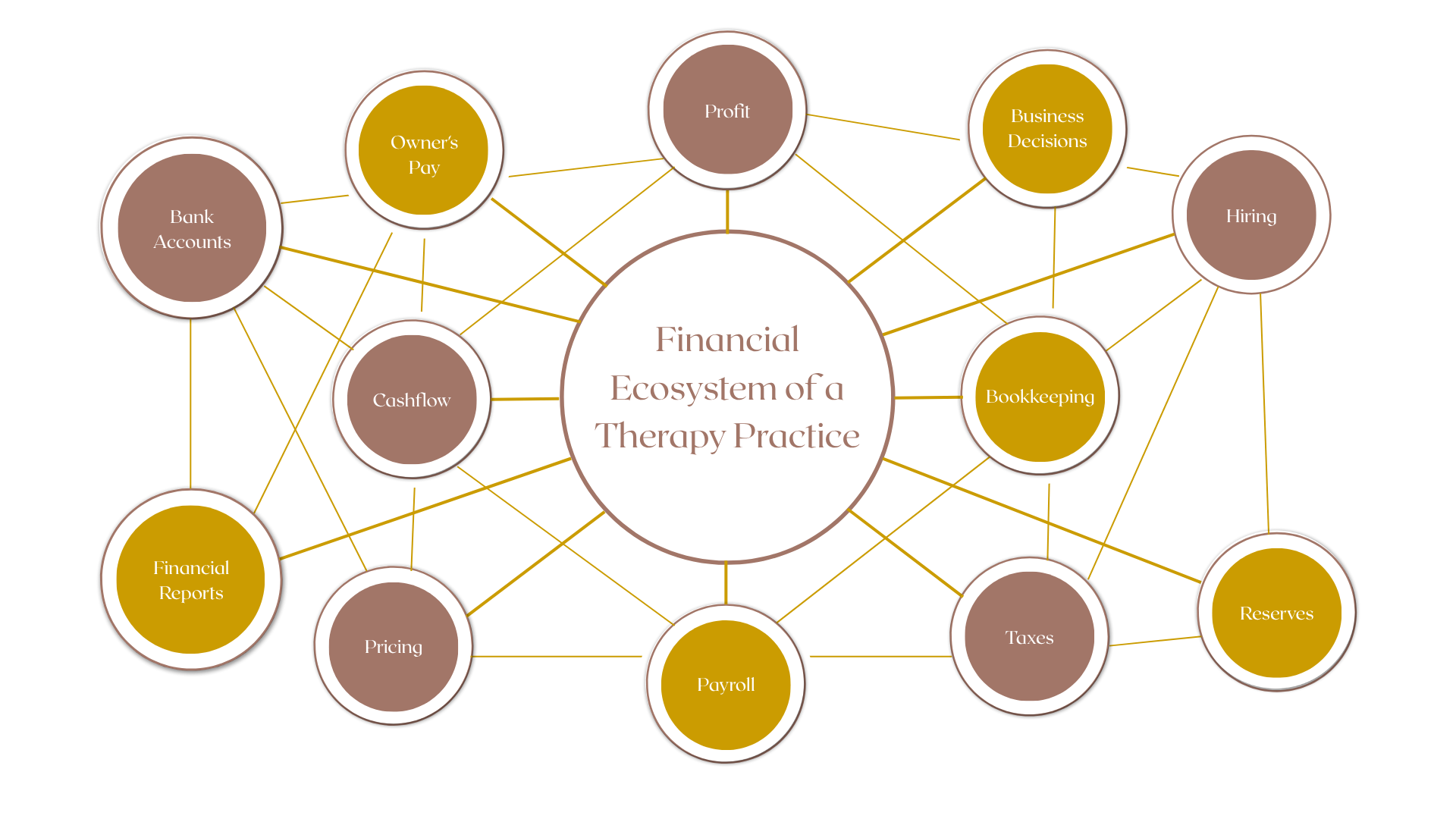
A financial ecosystem is simply the collection of financial systems that support your business. Each system has its own purpose, but they're designed to work together, not independently.
When one system changes, the others are affected too.
Here's the thing: every therapy practice already has a financial ecosystem.
The question is whether it was built by design or by default.
What does that actually look like?
Recently, I worked with a therapy practice owner whose bookkeeping was already accurate.
We weren't fixing transactions or cleaning up reports.
We were redesigning the financial systems around the books.
We talked about creating a more consistent owner's pay, building monthly financial routines that actually fit the way they work, setting money aside for taxes before they were due, and creating enough financial margin so taking time off didn't feel financially stressful.
None of those conversations were really about bookkeeping.
But every one of them depended on having accurate books.
That's what a healthy financial ecosystem looks like.
The bookkeeping system supported conversations about cash flow.
The cash flow system supported the owner's pay.
The owner's pay system supported personal goals.
Those personal goals influenced future business decisions.
The financial habits supported better decision-making.
Each system strengthened the others.
A different client has been with me for several years.
When we first started working together, most of our conversations focused on solving immediate financial challenges.
Today, our conversations have shifted from solving problems to making intentional decisions.
Now we're talking about how much to invest back into the business, balancing team growth with personal financial goals, reducing clinical hours over time, and making sure the business continues supporting the life they want to build.
The bookkeeping still matters.
The reports still matter.
But those aren't the only focus.
They're simply part of a much bigger conversation.
To me, that's another sign of a healthy financial ecosystem.
As the business evolves, the financial systems evolve with it.
Every financial ecosystem is unique.
Just like no two therapy practices are exactly alike, no two financial ecosystems should be either.
A healthy financial ecosystem doesn't necessarily mean building a seven-figure practice.
It doesn't mean maximizing profit at all costs.
It doesn't even mean every business should look the same.
To me, a healthy financial ecosystem is one that's intentionally designed to support your vision for your practice.
Maybe your goal is to work four days a week.
Maybe it's to build a small group practice.
Maybe it's to take six weeks off every year.
Maybe it's simply to stop feeling anxious every time you log into your bank account.
None of those goals are more "healthy" than the others.
What matters is that your financial systems are intentionally designed to support them.
There are, however, a few characteristics I do want to see in healthy financial ecosystems.
They create enough profit to keep the business sustainable.
Taxes are planned for instead of becoming a last-minute scramble.
The owner pays themselves consistently.
Financial decisions are made using reliable information, not guesswork.
And the business has enough flexibility to adapt as life changes.
Profit will always be part of the picture.
Not because profit is the ultimate goal.
Because profit keeps a business healthy.
It creates stability.
It allows you to invest in your team.
It gives you options when life or business changes.
Without profit, even the most meaningful practice eventually loses the ability to serve others well.
Every ecosystem is made up of financial systems.
Every practice already has financial systems.
Some were intentionally designed.
Others simply developed over time.
Some of the systems I think about most often include:
Bookkeeping – Organizing and maintaining accurate financial information.
Cash Flow – How money moves through your practice.
Owner's Pay – How and when you compensate yourself.
Profit – Creating financial margin for the future.
Taxes – Planning ahead instead of reacting.
Pricing – Making sure your fees support both your clients and your business.
Financial Reporting – Turning numbers into meaningful information.
Financial Habits – The routines that keep you connected to your business.
Decision-Making – Using the information from your financial systems to make confident choices.
Each system can function on its own.
But none of them reach their full potential in isolation.
When one system changes, the others feel it.
That's what makes it an ecosystem.
Built by design, not by default
One of my favorite parts of working with therapy practice owners is watching their perspective change.
At first, the questions are often tactical.
"How do I improve cash flow?"
"How do I prepare for taxes?"
"How do I pay myself more consistently?"
Those are important questions.
But over time, the questions become more intentional.
"How do I want my practice to support my life?"
"What financial systems need to change as my practice grows?"
"How can I make managing my business feel simpler?"
Those are ecosystem questions.
Because healthy businesses aren't built by solving one financial problem at a time.
They're built by intentionally designing financial systems that support one another, and ultimately support the vision you have for your practice.
The goal isn't to build someone else's version of a healthy practice.
It's to intentionally design a financial ecosystem that supports yours.
So here's the question I'd leave you with:
If you looked at your financial ecosystem today, would you say it was built by design or by default?