

Most financial systems are built by default, not by design
Most practice owners don't wake up one day and decide to create a complicated financial system.
It happens gradually.
A bank account gets opened because someone recommended it.
A spreadsheet gets created to solve a problem.
Payroll gets added.
A new software subscription gets connected.
A bookkeeper comes on board.
A CPA makes a recommendation.
Each decision makes sense on its own.
But over time, those individual decisions become the financial system that runs the practice.
The challenge is that very few owners ever stop to ask:
Was this system intentionally designed, or did it simply evolve over time?
Building a practice is different than designing a financial system
Most therapy practice owners are experts in clinical work, not financial system design.
As the practice grows, financial decisions are often made in response to immediate needs:
"I need a separate account for taxes."
"I should probably start payroll."
"My CPA said I should become an S-Corp."
"I need a way to track expenses."
"Everyone says I should implement Profit First."
None of these are bad decisions.
In fact, many of them are smart decisions.
The problem is that they're often made independently of one another.
As a result, the financial side of the business becomes a collection of tools, processes, and habits rather than a cohesive system.
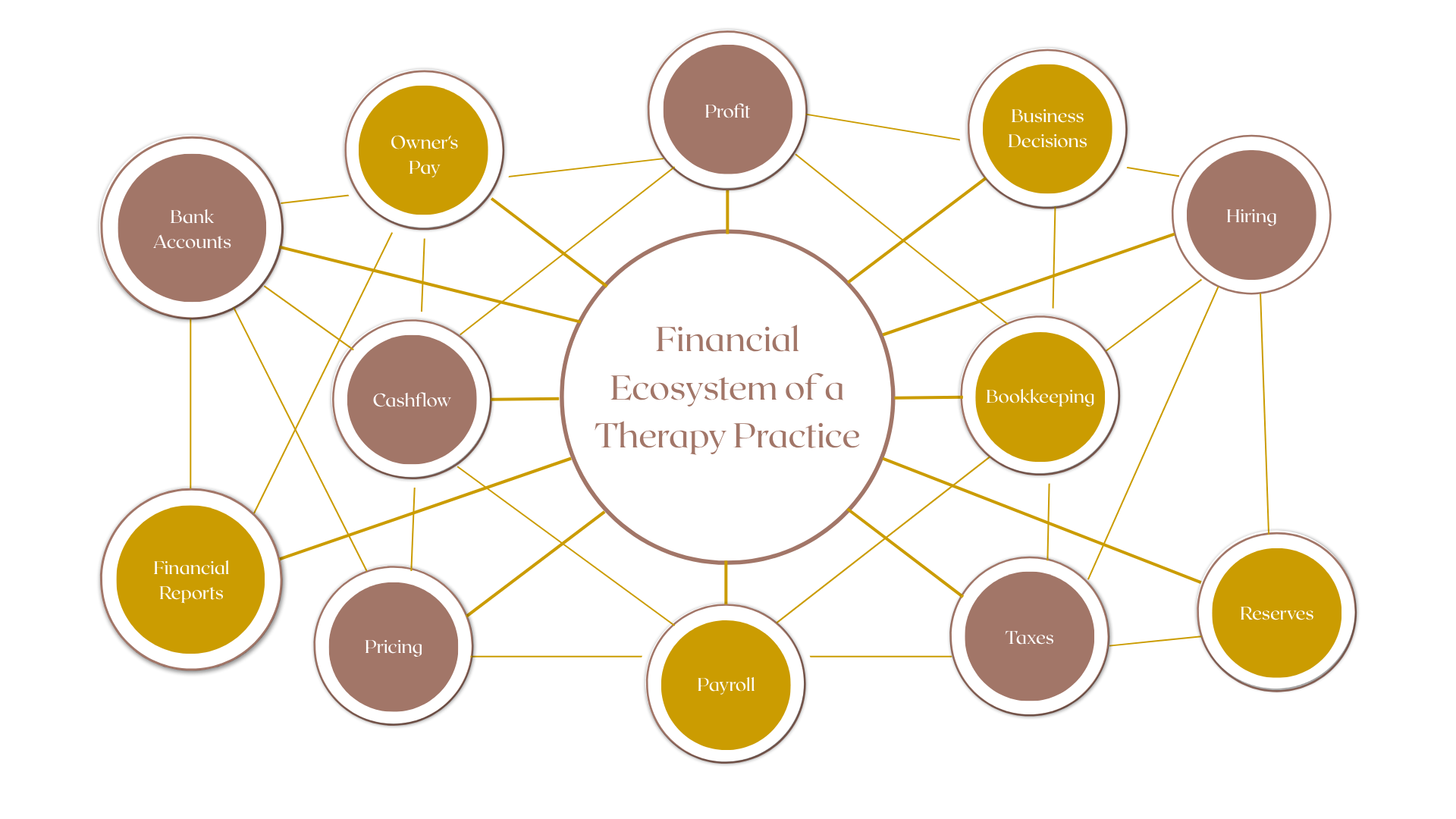
The signs your financial systems were built by default
Most practice owners don't realize their systems are creating friction because nothing appears to be "broken."
The bookkeeping gets done.
Payroll runs.
Taxes get filed.
Money comes in.
From the outside, everything looks fine.
Yet behind the scenes, you might find yourself:
Constantly moving money between accounts
Unsure how much to pay yourself
Avoiding financial reports because they don't feel useful
Feeling surprised by cash flow even when revenue is consistent
Struggling to make financial decisions with confidence
Wondering why managing the financial side of the practice feels harder than it should
These aren't necessarily signs of poor bookkeeping.
They're often signs that the financial systems supporting the business have never been intentionally designed to work together.
Financial clarity doesn't come from more information
One of the most common assumptions I see is that more information will solve the problem.
A new report.
A new spreadsheet.
Another bank account.
A different software.
But clarity doesn't come from adding more pieces.
It comes from understanding how the pieces fit together.
You can have accurate books and still feel uncertain about your finances.
You can review your reports every month and still struggle to make decisions.
You can implement someone else's financial strategy and still feel disconnected from your numbers.
Because financial clarity isn't created by information alone.
It's created when your financial systems align with the way you want to run your business.
Financial systems are designed through questions
When something feels off financially, most practice owners immediately start looking for a solution.
Should I open another account?
Should I switch bookkeeping software?
Should I implement Profit First?
Should I create another spreadsheet?
Those questions aren't necessarily wrong.
But they're often being asked too early.
The strongest financial systems aren't built by collecting tools.
They're built by asking better questions.
Before deciding what to change, it's important to understand what you're actually trying to accomplish.
Because if you solve the wrong problem, you'll likely end up adding more complexity instead of creating more clarity.
That's why financial system design starts with questions, not solutions.
Finding the friction
If you're not sure where to start, begin by exploring these three questions.
1. What feels harder than it should?
Not what's broken.
What's creating friction?
Maybe you're constantly moving money between accounts.
Maybe you're unsure how much to pay yourself.
Maybe you're reviewing reports but still don't feel confident making decisions.
Maybe you're spending more time managing money than you think you should.
Financial systems are designed to reduce friction. If something consistently feels harder than it should, that's usually a clue that a system needs attention.
2. What decision am I trying to make?
Most financial tools are designed to help you make decisions.
If you're thinking about opening a new bank account, ask yourself:
What decision will this help me make more easily?
If you're considering a new report, ask:
What decision will this report help me make?
If you're thinking about implementing a new strategy, ask:
What problem am I hoping this will solve?
If you can't clearly answer those questions, the problem may not be a missing tool.
It may be a missing design.
3. Is this system supporting the business I have today?
Many financial systems were created for an earlier version of the business.
The system that worked when you were a solo practice may not work for a group practice.
The process that worked at $150,000 in revenue may not work at $500,000.
The account structure that worked two years ago may not support where you're headed now.
Sometimes the problem isn't that the system is wrong.
It's that the business has outgrown it.
A simple place to start
Before closing this article, take a few minutes to write down your answers to these two questions:
What part of managing my practice's finances feels harder than it should?
What is one financial decision I wish felt easier to make?
Don't worry about finding the solution yet.
Just identify the friction and the decision.
That alone can provide more clarity than adding another account, report, or spreadsheet.
Because clarity rarely starts with finding the right tool.
It starts with understanding the real problem you're trying to solve.
By design, not by default
Healthy financial ecosystems aren't built by following someone else's checklist.
They're built by intentionally designing financial systems that support the practice—and life—you want to build.
The goal isn't to have more accounts, more reports, or more processes.
The goal is to create a financial ecosystem where every part works together.
Because the strongest financial systems aren't the ones that happen by default.
They're the ones built by design.